















Doctoral
Level
3 - 6 Years
Duration
-
Fee
55% marks
Master’s Degree or M.E./M.Tech./M.Sc. Engineering or equivalent.
Overview
The Department of Electronics and Communication Engineering (ECE) at Kishkinda University offers a Doctor of Philosophy (Ph.D.) programme that aims to promote advanced research, innovation, and technological development in emerging areas of electronics and communication engineering.
The programme is conducted in accordance with UGC Ph.D. Regulations and provides scholars with opportunities to undertake original, interdisciplinary research under the guidance of experienced faculty members. Research areas include wireless communication, signal and image processing, embedded systems, VLSI, Internet of Things (IoT), artificial intelligence, machine learning, sensor networks, robotics, and related technologies.
The programme emphasizes research methodology, scholarly publications, innovation, and industry-relevant solutions, preparing graduates for careers in academia, research organizations, and high-technology industries while contributing to scientific advancement and societal development.
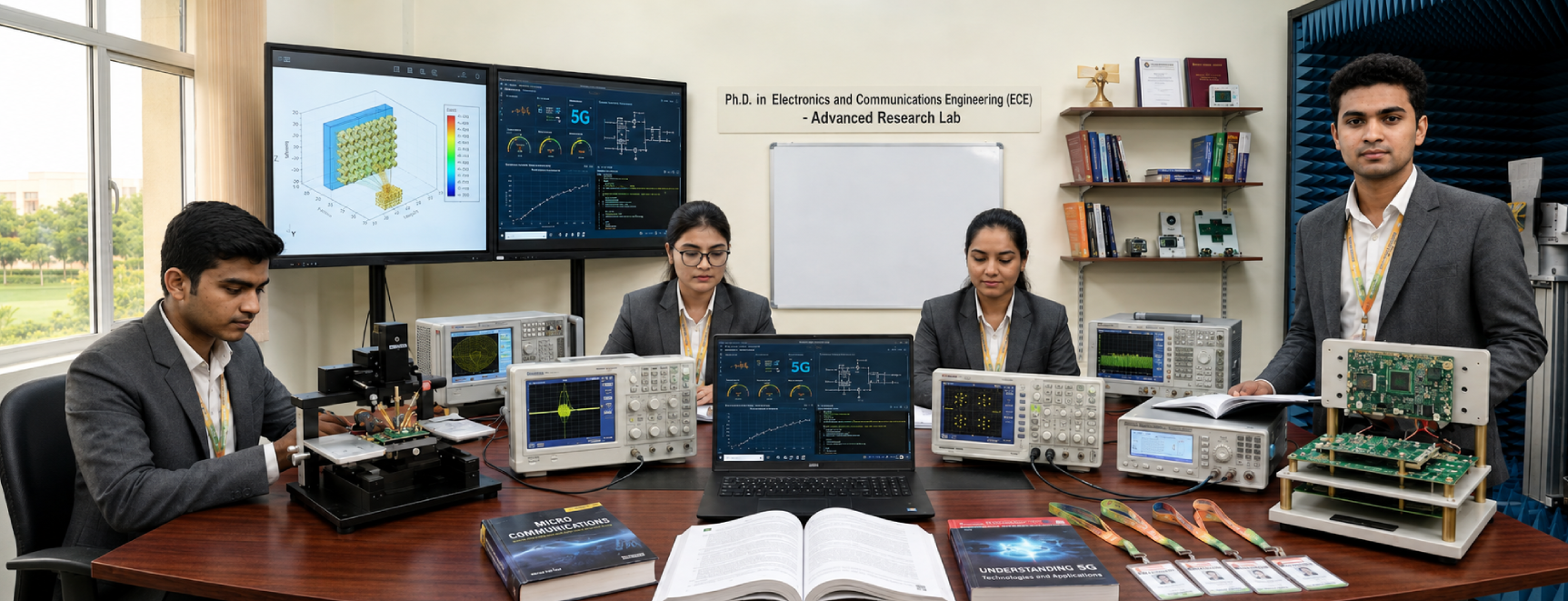
Eligibility
Candidates seeking admission to the Ph.D. program in Electronics and Communication Engineering (ECE) at Kishkinda University should fulfill the following eligibility requirements:Candidates must possess a Master’s Degree (M.E./M.Tech./M.S. or equivalent) in Electronics and Communication Engineering or related disciplines from a recognized university.Candidates should have obtained a minimum of 55% marks or equivalent CGPA in the qualifying postgraduate examination.Relaxation in minimum marks may be applicable for reserved category candidates as per university and government norms.Candidates with qualifications in relevant interdisciplinary areas such as Embedded Systems, VLSI, Communication Systems, Signal Processing, Electronics Engineering, or allied branches may also be considered.Admission to the Ph.D. program is generally based on the performance in the university entrance examination and/or interview conducted by the university research committee.Candidates who have qualified in national-level examinations such as UGC-NET, CSIR-NET, GATE, or equivalent may be given preference or exemption from the entrance test as per university regulations.Working professionals, faculty members, and industry researchers may also apply under part-time or external research categories subject to university norms and approval.


RESEARCH
The Department of Electronics and Communication Engineering
Places strong emphasis on innovation, scientific inquiry, and technological advancement through its dedicated Research and Development (R&D) initiatives. The department actively promotes a vibrant research ecosystem by encouraging faculty members, research scholars, and students to engage in high-quality interdisciplinary research across emerging areas of electronics, communication, embedded systems, signal processing, VLSI design, wireless communication, IoT, artificial intelligence, and allied domains.

Career Prospects

Professor / Academic Researcher
Opportunities in universities and higher education institutions as faculty members, researchers, and academic leaders.
Research Scientist
Careers in national and international research laboratories, R&D organizations, and innovation centers.
Electronics Design Engineer
Roles in designing electronic circuits, embedded systems, and communication devices.
VLSI and Semiconductor Engineer
Opportunities in chip design, semiconductor industries, and integrated circuit development.
Communication Systems Engineer
Careers in wireless communication, networking, satellite communication, and telecom industries.
Embedded Systems Engineer
Development of embedded hardware and software solutions for smart devices and automation systems.
Signal Processing Engineer
Roles involving audio, image, video, and communication signal analysis and processing.
IoT and Automation Specialist
Careers in smart systems, industrial automation, robotics, and Internet of Things applications.
Artificial Intelligence and Data Analytics Engineer
Application of AI, Machine Learning, and analytics in communication and electronics systems.
Research and Development (R&D) Engineer
Opportunities in product development, innovation, and advanced technology solutions.
Government and Public Sector Opportunities
Careers in organizations such as ISRO, DRDO, BEL, BHEL, BSNL, and other public sector enterprises.
Consultant and Technical Advisor
Advisory roles in technology firms, research organizations, and industrial projects.
Entrepreneurship and Startups
Opportunities to establish technology startups and innovation-driven enterprises in electronics and communication domains.





 Programme structure

