















Postgraduate
Level
2 Years
Duration
₹ 90K / ₹ 1.5L
Merit / Management Fee
60% marks
Sr. Secondary (10+2)
Overview
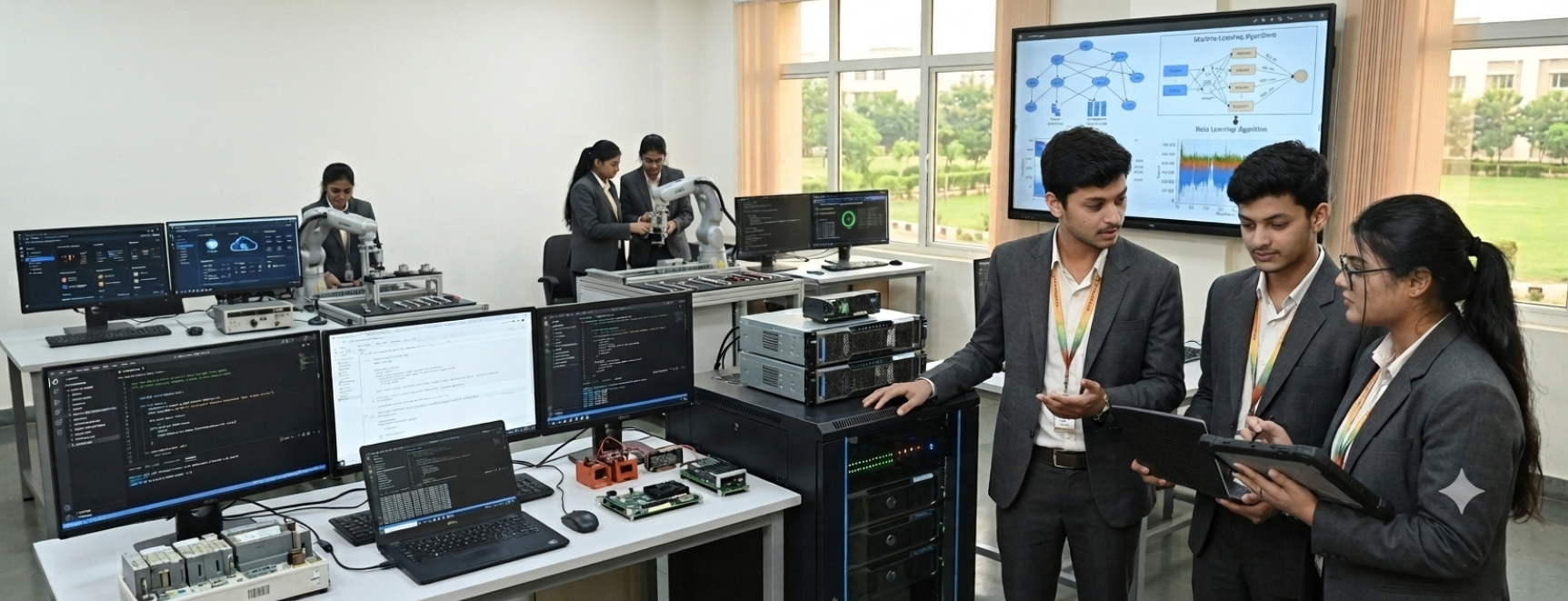
The Department of Computer Science and Engineering (CSE) is dedicated to excellence in teaching, research, and innovation in computing technologies. The department aims to develop skilled professionals with strong foundations in programming, algorithms, and system design, along with practical expertise to meet the evolving demands of the IT industry.
The curriculum integrates theoretical knowledge with hands-on learning through labs, projects, and internships. Students are trained to develop problem-solving, analytical, and technical skills required to build reliable and scalable software systems.
The department also emphasizes emerging areas such as Artificial Intelligence, Machine Learning, Data Science, Cloud Computing, and Cyber Security. With modern infrastructure, experienced faculty, and strong industry interaction, the department prepares students to become industry-ready professionals and innovative thinkers.
Eligibility
Candidates must have completed B.E / B.Tech / M.Sc / MCA in a relevant discipline for admission to M.Tech (CSE).A minimum of 50% aggregate marks is required (45% for reserved categories)


Teaching Pedagogies
The Computer Science and Engineering (CSE) program at Kishkinda University adopts innovative and student-centered teaching pedagogies to enhance technical knowledge, problem-solving ability, creativity, and industry readiness. The teaching-learning process combines theoretical concepts with practical implementation to ensure holistic development of students
- Interactive Classroom Teaching
- Project-Based Learning
- Experiential Learning
- Outcome-Based Education (OBE)
- Case Study and Problem-Solving Methods
- Industry Interaction and Expert Sessions
- Collaborative Learning and Team Projects
- Research and Innovation-Oriented Learning
- Continuous Evaluation and Coding Assessments
Interactive Classroom Teaching

Interactive Classroom Teaching
Concept-oriented lectures using smart boards, multimedia presentations, coding demonstrations, and active student participation to enhance understanding of computer science concepts.
Project-Based Learning
Experiential Learning
Outcome-Based Education (OBE)
Case Study and Problem-Solving Methods
Industry Interaction and Expert Sessions
Collaborative Learning and Team Projects
Research and Innovation-Oriented Learning
Continuous Evaluation and Coding Assessments
The department emphasizes emerging technologies such as Artificial Intelligence, Machine Learning, Data Science, Cyber Security, Cloud Computing, Blockchain Technology, and Internet of Things (IoT) to prepare students for industry and research opportunities.
Specialization

Artificial Intelligence and Machine Learning
Development of intelligent systems, predictive models, and automation technologies.
Data Science and Analytics
Analysis of large datasets, data visualization, and business intelligence applications.
Cyber Security
Protection of computer systems, networks, and digital information from cyber threats.
Cloud Computing
Study of cloud platforms, virtualization, and distributed computing technologies.
Software Engineering
Software development methodologies, testing, maintenance, and project management practices.
Full Stack Development
Front-end and back-end web application development using modern technologies.
Blockchain Technology
Study of decentralized systems, cryptocurrencies, and secure digital transactions.
Computer Networks
Networking concepts, communication protocols, and network security principles.
Big Data Technologies
Processing and analysis of large-scale structured and unstructured data.
Human-Computer Interaction
– Design of user-friendly interfaces and interactive computing systems.
DevOps and Automation
Continuous integration, deployment, and automation practices in software development.
Program Educational Objectives (PEOs)
PEO - 1
Graduates will create innovative solutions to global challenges using their computer science expertise.
PEO - 2
Graduates will lead with integrity, making decisions that benefit society and the environment.
PEO - 3
Graduates will pursue ongoing learning and research to stay at the forefront of technological advancements.
Program Outcomes (PO)
PO - 1
Engineering Knowledge: Apply principles of mathematics, natural sciences, computing, engineering fundamentals, and specialized engineering knowledge to develop solutions for complex engineering problems.
PO - 2
Problem Analysis: Identify, formulate, and analyse complex engineering problems by reviewing research literature and drawing well-founded conclusions, while considering sustainable development.
PO - 3
Design/Development of Solutions: Design innovative solutions for complex engineering problems and develop systems, components, or processes that address identified needs, considering public health and safety, whole-life cost, net-zero carbon goals, culture, society, and environmental impact.
PO - 4
Conduct Investigations of Complex Problems: Utilize research-based knowledge to investigate complex engineering problems, incorporating experiment design, modelling, data analysis, and interpretation to derive valid conclusions.
PO - 5
Engineering Tool Usage: Develop, select, and apply appropriate techniques, resources, and modern engineering and IT tools, including prediction and modelling, while recognizing their limitations in solving complex engineering problems.
PO - 6
The Engineer and the World: Assess and evaluate societal and environmental factors when addressing complex engineering problems, considering their impact on sustainability in relation to the economy, health, safety, legal frameworks, culture, and the environment.
PO - 7
Ethics: Uphold ethical principles, demonstrate commitment to professional integrity, respect human values, and promote diversity and inclusion while adhering to national and international laws.
PO - 8
Individual and Team Collaboration: Work effectively both independently and as a member or leader in diverse, multidisciplinary teams.
PO - 9
Communication: Communicate clearly and inclusively within the engineering community and society, demonstrating the ability to write effective reports, develop design documentation, and deliver impactful presentations while considering cultural, language, and learning differences.
PO - 10
Project Management and Finance: Apply engineering management principles and economic decision-making to one’s work, effectively managing projects and contributing as both a team member and leader in multidisciplinary environments.
PO - 11
Life-Long Learning: Acknowledge the importance of continuous learning and cultivate the skills necessary for:
i) Independent and sustained self-improvement,
ii) Adaptability to evolving and emerging technologies, and
iii) Critical thinking in the broader landscape of technological advancements.
Program Specific Outcomes (PSO)
PSO - 1
Develop proficiency in applying programming principles, algorithms, and modern software engineering practices to design, develop, and deploy robust software solutions across various platforms.
PSO - 2
Cultivate skills in employing data analysis techniques, machine learning models, and AI tools to extract insights, drive innovation, and support decision-making in real-world applications.
PSO - 3
Acquire proficiency to design, implement, and manage complex computer-based systems, ensuring seamless integration of hardware and software components to meet the specified needs.

Scholarship
Kishkinda University supports eligible students in availing Government Scholarships through recognized portals such as SSP (State Scholarship Portal) and NSP (National Scholarship Portal). Students who meet the eligibility criteria can apply directly through these official portals and complete the scholarship process as per government guidelines.
Available Scholarship Portals
SSP – State Scholarship Portal
For students eligible under Karnataka State Government scholarship schemes.
NSP – National Scholarship Portal
For Central Government scholarship schemes applicable across India.
How to Apply
-
01

Visit the official SSP or NSP portal.
-
02

Register with required academic and personal details.
-
03

Upload necessary documents (income certificate, caste certificate, marks cards, Aadhaar, etc.)
-
04

Submit the application online within the specified deadline.
-
05

Submit acknowledgment copy to the University Scholarship/Accounts Section (if required).
Career Prospects
Core Career Opportunities
- Software Developer / Engineer
- Data Scientist / Data Analyst
- Cyber Security Analyst
- Cloud Engineer / DevOps Engineer
- AI / Machine Learning Engineer
Emerging Technology Domains
- Artificial Intelligence & Machine Learning
- Blockchain Technology
- Internet of Things (IoT)
- Augmented Reality (AR) & Virtual Reality (VR)
- Robotics and Automation
Industry and Employment Opportunities
- IT Service Companies
- Product-based Companies
- Startups and Entrepreneurship
- Government and Public Sector Jobs
- Research Organizations
Higher Studies and Research
- M.Tech / MS Programs
- MBA (Technology Management)
- PhD and Research Opportunities
- Professional Certifications
Entrepreneurship and Other Paths
- Startups and Innovation
- Freelancing and Remote Jobs
- Teaching and Academia
- Technical Content Creation
FAQ's
It is a postgraduate program focused on advanced concepts in computer science, research, and emerging technologies.





 Programme structure

