













Undergraduate
Level
3 Years
Duration
₹ 60K / ₹ 1.0L
Merit / Management Quota
60% marks
Sr. Secondary (10+2)
 Brochure
Overview
The Department of Computer application is established with the objective of imparting quality education in the field of Computer science and applications which strives to shape outstanding computer professionals.
The Department has modern facilities for teaching, learning and research. The Department offers a wide range of research opportunities and programs of study at undergraduate and postgraduate level. The training imparted aims to prepare young minds for the challenging opportunities in the IT industry with a global awareness supported by experts in the field of Computer Science.
The programs of the department are designed to equip students with problem-solving ability, programming proficiency, and system design skills, enabling them to build reliable and scalable software and computing solutions.

Eligibility
Candidates must have completed 10+2 (Science / Commerce / Arts) or a 3-year Diploma.

Teaching Pedagogies
The Bachelor of Computer Applications (BCA) and Master of Computer Applications (MCA) programs at Kishkinda University adopt innovative, technology-driven, and industry-oriented teaching pedagogies to develop students’ expertise in computer applications, software development, programming, and emerging technologies. The teaching-learning process combines theoretical concepts with practical implementation to prepare students for careers in IT industries, software development, research, and entrepreneurship.
- Interactive Classroom Teaching
- Project-Based Learning
- Experiential Learning
- Outcome-Based Education (OBE)
- Case Study and Problem-Solving Methods
- Industry Interaction and Expert Sessions
- Collaborative Learning and Team Projects
- Research and Innovation-Oriented Learning
- Continuous Evaluation and Skill Assessments
Interactive Classroom Teaching
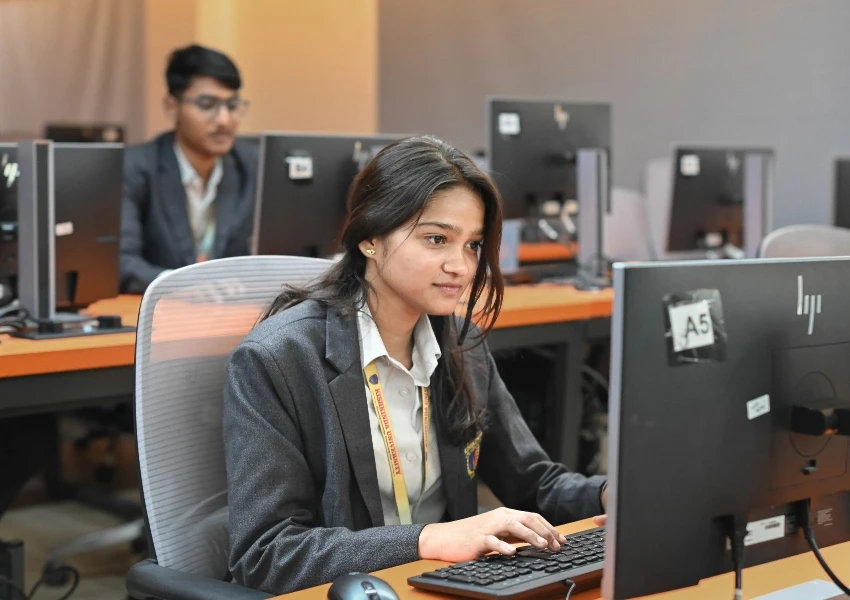
Interactive Classroom Teaching
Concept-oriented lectures using smart boards, multimedia presentations, coding demonstrations, and active student participation for effective understanding of computing concepts.
Project-Based Learning
Experiential Learning
Outcome-Based Education (OBE)
Case Study and Problem-Solving Methods
Industry Interaction and Expert Sessions
Collaborative Learning and Team Projects
Research and Innovation-Oriented Learning
Continuous Evaluation and Skill Assessments
Specialization

Programming and Software Development
Design and development of software applications using modern programming languages.
Web Technologies
Development of dynamic websites, web applications, and online platforms.
Database Management Systems
Design, implementation, and management of relational and non-relational databases.
Artificial Intelligence and Machine Learning
Development of intelligent systems and predictive analytical models.
Data Science and Analytics
Collection, processing, visualization, and analysis of large datasets.
Cyber Security
Protection of digital systems, networks, and information from cyber threats.
Cloud Computing
Study of cloud platforms, virtualization, and distributed computing technologies.
Mobile Application Development
Design and development of Android and cross-platform mobile applications.
Internet of Things (IoT)
Development of smart connected devices and IoT-based applications.
Full Stack Development
Front-end and back-end application development using modern frameworks and technologies.
Blockchain Technology
Study of decentralized systems and secure digital transaction technologies.
Computer Networks
Networking concepts, communication protocols, and network administration.
Software Testing and Quality Assurance
Techniques for software testing, debugging, and quality management.

Business Intelligence and Analytics
Use of analytical tools and technologies for business decision-making.
Entrepreneurship and Innovation
Development of startup ideas, innovative software solutions, and business applications.
Program Educational Objectives (PEOs)
PEO - 1
Graduates will build successful careers in software development, data analytics, AI/ML, and application engineering by demonstrating strong technical skills and adaptability to emerging technologies.
PEO - 2
Graduates will apply computer application knowledge, tools, and practices with professionalism, ethics, teamwork, and effective communication to address organizational and societal needs.
Program Outcomes (PO)
PO - 1
Engineering Knowledge: Apply principles of mathematics, natural sciences, computing, engineering fundamentals, and specialized engineering knowledge to develop solutions for complex engineering problems.
PO - 2
Problem Analysis: Identify, formulate, and analyse complex engineering problems by reviewing research literature and drawing well-founded conclusions, while considering sustainable development.
PO - 3
Design/Development of Solutions: Design innovative solutions for complex engineering problems and develop systems, components, or processes that address identified needs, considering public health and safety, whole-life cost, net-zero carbon goals, culture, society, and environmental impact.
PO - 4
Engineering Tool Usage: Develop, select, and apply appropriate techniques, resources, and modern engineering and IT tools, including prediction and modelling, while recognizing their limitations in solving complex engineering problems.
PO - 5
Individual and Team Collaboration: Work effectively both independently and as a member or leader in diverse, multidisciplinary teams.
PO - 6
Project Management and Finance: Apply engineering management principles and economic decision-making to one’s work, effectively managing projects and contributing as both a team member and leader in multidisciplinary environments.
PO - 7
Ethics: Uphold ethical principles, demonstrate commitment to professional integrity, respect human values, and promote diversity and inclusion while adhering to national and international laws.
PO - 8
Life-Long Learning: Acknowledge the importance of continuous learning and cultivate the skills necessary for:
i) Independent and sustained self-improvement,
ii) Adaptability to evolving and emerging technologies, and
iii) Adaptability to evolving and emerging technologies, and
Program Specific Outcomes (PSO)
PSO - 1
Students will design, develop, and manage software solutions using core computing technologies, including Python, R, DevOps tools, and CI/CD workflows.
PSO - 2
Students will apply Al and ML techniques to model, analyze, and solve complex real-world problems across multidisciplinary domains.
PSO - 3
Students will apply data science methodologies to enhance organizational decision-making and strategic planning.

Scholarship
Kishkinda University supports eligible students in availing Government Scholarships through recognized portals such as SSP (State Scholarship Portal) and NSP (National Scholarship Portal). Students who meet the eligibility criteria can apply directly through these official portals and complete the scholarship process as per government guidelines.
Available Scholarship Portals
SSP – State Scholarship Portal
For students eligible under Karnataka State Government scholarship schemes.
NSP – National Scholarship Portal
For Central Government scholarship schemes applicable across India.
How to Apply
-
01

Visit the official SSP or NSP portal.
-
02

Register with required academic and personal details.
-
03

Upload necessary documents (income certificate, caste certificate, marks cards, Aadhaar, etc.).
-
04

Submit the application online within the specified deadline.
-
05

Submit acknowledgment copy to the University Scholarship/Accounts Section (if required).
Career Prospects
Core Career Opportunities
- Software Developer / Programmer
- Web Developer
- System Administrator
- Database Administrator
- Technical Support Engineer
Emerging Technology Domains
- Web and Mobile Application Development
- Data Analytics
- Cloud Computing
- Cyber Security
- Artificial Intelligence (Basics)
Industry and Employment Opportunities
- IT Companies and Software Firms
- Startups and Tech Companies
- Banking and Financial Institutions
- Government Organizations
- E-commerce and Service Industries
Higher Studies and Research
- MCA (Master of Computer Applications)
- MBA (IT / Systems Management)
- Professional Certifications (Cloud, Data Analytics, Cyber Security)
Entrepreneurship and Other Paths
- Freelancing and Web Development Services
- Startup Development
- Technical Support Services
- Teaching and Academia
FAQ's
BCA is a 3-year undergraduate program focused on computer applications, programming, and software development.





 Programme structure

