















Undergraduate
Level
4 Years
Duration
₹ 1.75L / ₹ 2.0L
Merit / Management Fee
60% marks
Sr. Secondary (10+2)
 Brochure
Overview
The Department of Electronics and Communication Engineering is committed to providing quality education with a strong foundation in core electronics and communication technologies.
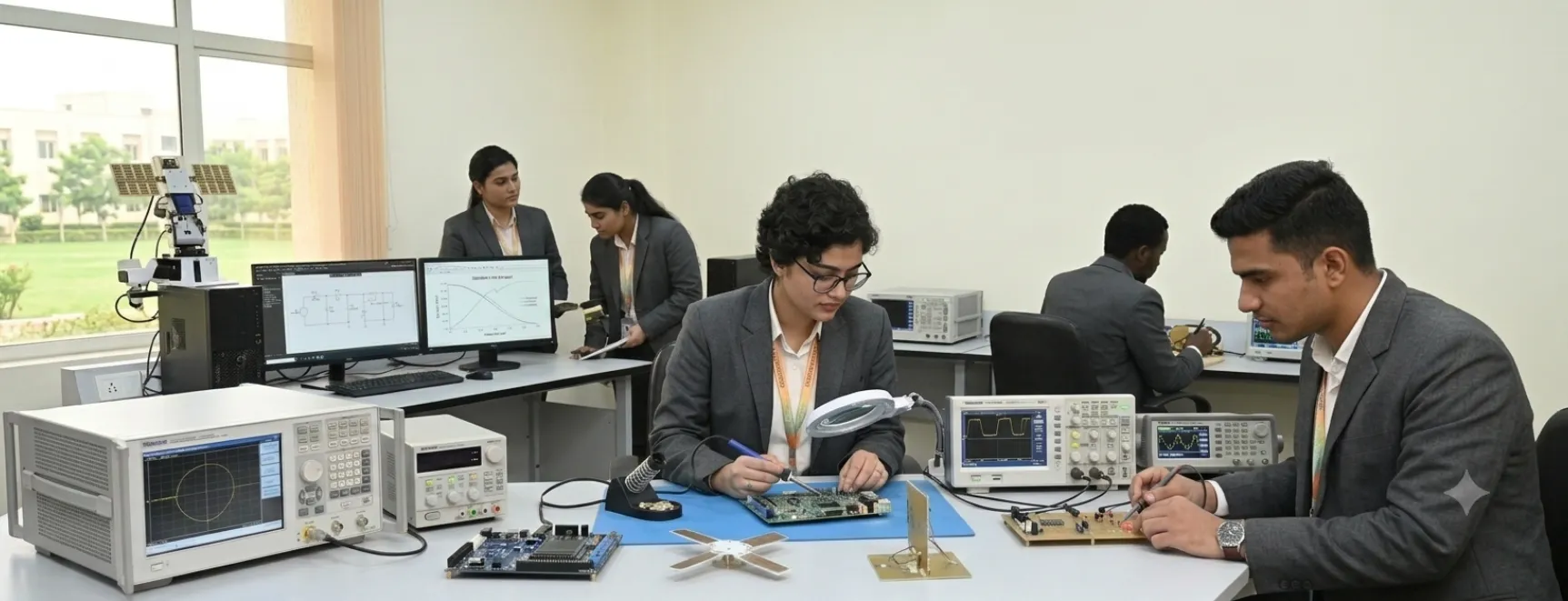
The department emphasizes a balanced approach to theory, practical learning, research, and industry interaction. Well-equipped laboratories, experienced faculty, and outcome-based education support student development. Students are encouraged to participate in projects, internships, and technical activities.
The department strives to produce skilled, innovative, and ethically responsible engineers to meet industry and societal needs.
Eligibility
10+2 with Physics & Mathematics + Chemistry / CS / Biology

Teaching Pedagogies
The Computer Science and Engineering (Artificial Intelligence & Data Science) program at Kishkinda University adopts innovative, technology-driven, and industry-oriented teaching pedagogies to develop students’ expertise in intelligent systems, data-driven technologies, and advanced computing applications. The program combines theoretical learning with practical implementation to prepare students for emerging careers in AI, Machine Learning, Data Science, and automation technologies.
- Interactive Classroom Teaching
- Project-Based Learning
- Experiential Learning
- Outcome-Based Education (OBE)
- Case Study and Problem-Solving Methods
- Industry Interaction and Expert Sessions
- Collaborative Learning and Team Projects
- Research and Innovation-Oriented Learning
- Continuous Evaluation and Technical Assessments
Interactive Classroom Teaching

Interactive Classroom Teaching
Concept-oriented lectures using smart boards, multimedia presentations, circuit simulations, and digital learning tools for effective understanding of electronics and communication concepts.
Project-Based Learning
Experiential Learning
Outcome-Based Education (OBE)
Case Study and Problem-Solving Methods
Industry Interaction and Expert Sessions
Collaborative Learning and Team Projects
Research and Innovation-Oriented Learning
Continuous Evaluation and Technical Assessments
The department emphasizes emerging technologies such as Embedded Systems, VLSI Design, Internet of Things (IoT), Wireless Communication, Signal Processing, Artificial Intelligence, Robotics, Semiconductor Technologies, and Communication Networks.
Specialization

Embedded Systems
Design and development of hardware-integrated intelligent systems and applications.
VLSI Design
Study of integrated circuit design, semiconductor technologies, and chip development.
Wireless Communication
Communication technologies including mobile networks, satellite systems, and wireless protocols.
Signal and Image Processing
Processing and analysis of audio, video, image, and communication signals.
Internet of Things (IoT)
Development of smart connected devices and intelligent communication systems.
Communication Networks
Design and management of wired and wireless communication networks.
Artificial Intelligence in Electronics
Application of AI techniques in electronics, automation, and communication systems.
Robotics and Automation
Development of automated systems, robotic technologies, and intelligent control applications.
Microcontrollers and Microprocessors
Programming and interfacing of embedded hardware systems.
Digital Electronics
Study of digital circuits, logic systems, and electronic device design.
Analog Communication Systems
Principles and applications of analog communication technologies.
Optical and Fiber Communication
High-speed communication using optical fiber and photonic technologies.
RF and Microwave Engineering
Design and analysis of radio frequency and microwave communication systems.
Semiconductor Technologies
Study of semiconductor devices, fabrication, and electronic materials.
Control Systems Engineering
Analysis and design of automated control and feedback systems.
Program Educational Objectives (PEOs)
PEO - 1
To acquire strong knowledge in Basic Science, Mathematics and ability to apply this knowledge in the relevant fields of Electronics & Communication Engineering.
PEO - 2
To develop technical competence and uplift research ability to solve real time problems.
PEO - 3
To obtain professional Excellency through lifelong learning and produce graduates with professional values.
Program Outcomes (PO)
PO - 1
Engineering Knowledge: Apply principles of mathematics, natural sciences, computing, engineering fundamentals, and specialized engineering knowledge to develop solutions for complex engineering problems.
PO - 2
Problem Analysis: Identify, formulate, and analyse complex engineering problems by reviewing research literature and drawing well-founded conclusions, while considering sustainable development.
PO - 3
Design/Development of Solutions: Design innovative solutions for complex engineering problems and develop systems, components, or processes that address identified needs, considering public health and safety, whole-life cost, net-zero carbon goals, culture, society, and environmental impact.
PO - 4
Conduct Investigations of Complex Problems: Utilize research-based knowledge to investigate complex engineering problems, incorporating experiment design, modelling, data analysis, and interpretation to derive valid conclusions.
PO - 5
Engineering Tool Usage: Develop, select, and apply appropriate techniques, resources, and modern engineering and IT tools, including prediction and modelling, while recognizing their limitations in solving complex engineering problems.
PO - 6
The Engineer and the World: Assess and evaluate societal and environmental factors when addressing complex engineering problems, considering their impact on sustainability in relation to the economy, health, safety, legal frameworks, culture, and the environment.
PO - 7
Ethics: Uphold ethical principles, demonstrate commitment to professional integrity, respect human values, and promote diversity and inclusion while adhering to national and international laws.
PO - 8
Individual and Team Collaboration: Work effectively both independently and as a member or leader in diverse, multidisciplinary teams.
PO - 9
Communication: Communicate clearly and inclusively within the engineering community and society, demonstrating the ability to write effective reports, develop design documentation, and deliver impactful presentations while considering cultural, language, and learning differences.
PO - 10
Project Management and Finance: Apply engineering management principles and economic decision-making to one’s work, effectively managing projects and contributing as both a team member and leader in multidisciplinary environments.
PO - 11
Life-Long Learning: Acknowledge the importance of continuous learning and cultivate the skills necessary for:
i) Independent and sustained self-improvement,
ii) Adaptability to evolving and emerging technologies, and
iii) Critical thinking in the broader landscape of technological advancements.
Program Specific Outcomes (PSO)
PSO - 1
To understand the principles, processes, techniques and design aspects of electronic devices, circuits and communication systems.
PSO - 2
To apply, analyse and design electronic circuits, communication systems, embedded systems by using higher engineering mathematical foundations, computational principles and network modelling skills.
PSO - 3
To develop electronic hardware and software systems for universal requirements using sensors, embedded controllers, signal processors, analog and digitally integrated chips.

Scholarship
Kishkinda University supports eligible students in availing Government Scholarships through recognized portals such as SSP (State Scholarship Portal) and NSP (National Scholarship Portal). Students who meet the eligibility criteria can apply directly through these official portals and complete the scholarship process as per government guidelines.
Available Scholarship Portals
SSP – State Scholarship Portal
For students eligible under Karnataka State Government scholarship schemes.
NSP – National Scholarship Portal
For Central Government scholarship schemes applicable across India.
How to Apply
-
01

Visit the official SSP or NSP portal.
-
02

Register with required academic and personal details.
-
03

Upload necessary documents (income certificate, caste certificate, marks cards, Aadhaar, etc.)
-
04

Submit the application online within the specified deadline.
-
05

Submit acknowledgment copy to the University Scholarship/Accounts Section (if required).
Career Prospects
Core Career Opportunities
- Electronics Engineer
- Embedded Systems Engineer
- VLSI Design Engineer
- Communication Engineer
- Signal Processing Engineer
Emerging Technology Domains
- Internet of Things (IoT)
- 5G and Wireless Communication
- Robotics and Automation
- Artificial Intelligence in Electronics
- Semiconductor and Chip Design
Industry and Employment Opportunities
- Electronics and Semiconductor Industries
- Telecommunication Companies
- IT and Software Companies
- Core Engineering Companies
- Government and Public Sector Jobs
Higher Studies and Research
- M.Tech / MS in VLSI, Communication, Embedded Systems
- MBA (Technology / Operations)
- PhD and Research Opportunities
- Specialized Certifications
Entrepreneurship and Other Paths
- Electronics Product Development
- Startups in IoT and Embedded Systems
- Freelancing and Consulting
- Teaching and Academia
FAQ's
The department offers undergraduate, postgraduate, and research programs in Electronics and Communication Engineering.





 Programme structure

